
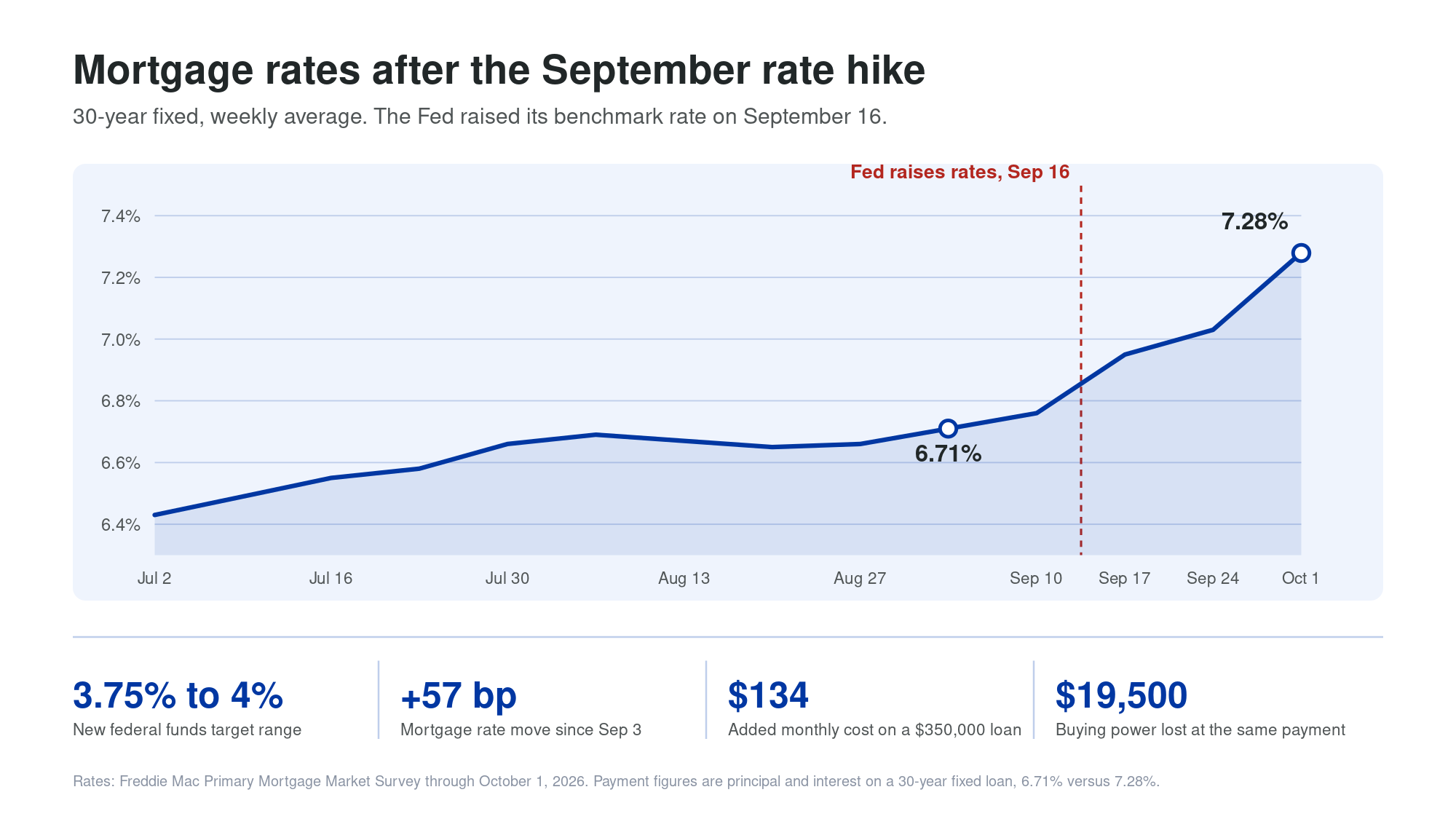
On September 16 the Federal Reserve raised its benchmark interest rate by a quarter point, to a target range of 3.75 to 4 percent. It was the first increase since 2023, and the vote was unanimous. Inflation running above target was the main reason given.
Most coverage of a Fed decision is written for people who own stocks. This is written for people who want to own a house. Here is what actually changed, what it costs you, and what it means if you are working toward a purchase through a rent-to-own agreement.
The Fed Does Not Set Your Mortgage Rate
This trips up almost everyone, so it is worth getting straight before anything else.
The Fed sets the federal funds rate, which is what banks charge each other overnight. It directly drives credit cards, car loans, and home equity lines. It does not directly set 30-year mortgage rates. Those track the 10-year Treasury yield and the mortgage bond market, which move on what investors expect inflation and growth to do over the next decade.
That is why a Fed cut sometimes arrives and mortgage rates go up anyway. The bond market had already priced in the expected move and reacted to the Fed’s commentary instead.
This time the two moved together. Mortgage rates had been drifting up through the summer, and the hike plus the Fed’s signal that another increase is likely before year end pushed them through a level buyers watch closely.
What It Costs In Dollars
The 30-year fixed average went from 6.71 percent in early September to 7.28 percent on October 1, according to Freddie Mac. That is six straight weeks of increases and the highest level since late 2023.
On a $350,000 loan over 30 years, here is the difference in principal and interest:
- At 6.71 percent, roughly $2,261 a month.
- At 7.28 percent, roughly $2,395 a month.
- That is about $134 more every month, close to $1,600 a year, and roughly $48,000 in additional interest over the full term.
There is a second way to look at the same number that matters more for house hunting. If your budget supports a payment of about $2,261, that payment financed a $350,000 loan a month ago. Today it finances closer to $330,500. The rate move cost you roughly $19,500 of buying power without anybody changing a list price.
For anyone who was already at the edge of qualifying, that is the difference between an approval and a decline, and it happened without any change to your income or your credit.
What The Fed Signaled Next
The projections released alongside the decision matter as much as the decision itself.
- Sixteen of the eighteen participants expect one more quarter point increase before the end of 2026.
- A few expect two more.
- The median projection shows no change through 2027.
- Cuts do not appear in the median path until 2028 and 2029.
The next meeting is October 27 and 28. These are projections rather than promises, and the Fed has changed course before when the data turned. But the honest reading today is that the era of waiting for rates to fall has been pushed out by a couple of years, not a couple of months.
If your plan was to hold off buying until mortgage rates came back down, that plan now has a much longer timeline than it did in August.
What This Means For Rent-To-Own
This is where the picture gets more interesting, because a rate increase cuts in several directions at once for anyone on a lease-purchase path.
Sellers get more flexible
Every time rates rise, a slice of the buyer pool stops qualifying. Sellers notice that their listing is getting fewer showings and weaker offers. A seller who would not have considered a lease-purchase arrangement at 6 percent becomes considerably more open to one at 7.3 percent, because the alternative is another three months of carrying costs.
That is leverage, and it is the clearest short-term benefit of this environment for a rent-to-own buyer.
Rent credits are worth more than they were
Here is a point most people miss. The value of the down payment you build during the lease period scales with the interest rate on the loan you eventually take out.
Every $20,000 in accumulated credits and savings reduces your monthly payment by about $129 at 6.71 percent. At 7.28 percent the same $20,000 saves you about $137 a month. The higher the rate, the harder each dollar of down payment works for you.
So if you are negotiating now, the credit percentage is worth pushing on harder than it was six months ago. Our guide on negotiating rent-to-own terms covers how to approach that conversation.
Think hard about the locked purchase price
A fixed purchase price set at signing is the standard structure, and it was enormously valuable when prices were climbing ten percent a year. That is not the current market.
Prices have been close to flat nationally, asking prices have been drifting down, and a higher rate environment puts further downward pressure on them. Locking a price today means betting that values rise between now and your closing. If instead values slip, you are contractually committed to a number above market, and your lender will appraise the home at the lower figure.
Two ways to handle that. Negotiate the locked price below today’s market rather than at or above it, or negotiate a price set by appraisal at closing with a ceiling. Either is more defensible right now than accepting an optimistic fixed number.
Your exercise date may land in a better rate environment
Here is the genuinely encouraging part. The Fed’s own projections put rate cuts in 2028 and 2029. A rent-to-own agreement signed today with a two or three year option period puts your mortgage application right around the window where the Fed expects to be easing.
Nobody can promise that. Projections move. But structurally, an arrangement that lets you occupy the home now and finance it later is a reasonable response to a market where borrowing is expensive today and expected to be less so later. That is a better argument for rent-to-own than it was a year ago.
What To Do In The Next 90 Days
- Re-run your numbers at 7.3 percent, not at the rate you saw last spring. Know the payment you can actually carry before you look at another listing.
- Attack your credit score now. The spread between a 620 and a 740 borrower is worth more in absolute dollars when the base rate is high. This is the single highest-return thing you can do during a lease period.
- Push for a larger rent credit percentage. See the math above. It is worth more today than it was in the spring.
- Do not let rate panic rush you into bad contract terms. A punishing agreement signed in a hurry costs far more than half a point of interest. Our pre-signing checklist is the thing to read before you commit.
- Ask lenders about buydowns and adjustable products. With sellers and builders under pressure, rate buydowns are being offered more freely than they were. They are worth asking about even if you end up declining.
The Short Version
Borrowing got more expensive and is likely to stay that way into 2027. That is genuinely bad news for anyone planning to take out a mortgage in the next twelve months.
It is a more mixed picture for rent-to-own. Your negotiating position with sellers improved, your rent credits buy more relief than they used to, and your eventual financing date may fall in a friendlier part of the cycle. The trade is that you need to be more careful about the purchase price you agree to, because the tailwind of rising values is not there to bail out an optimistic number.
Use the lease period for what it is for. Build the down payment, fix the credit file, and be ready to move when the financing window opens.
Rate figures are from the Freddie Mac Primary Mortgage Market Survey through October 1, 2026, and the Federal Reserve’s September 2026 policy statement and projections. Payment examples are principal and interest only on a 30-year fixed loan and exclude taxes, insurance, and mortgage insurance. This article is general information, not financial, tax, or legal advice. Rates change daily and your own terms will depend on your credit, down payment, loan type, and lender. Talk to a licensed mortgage professional and have a real estate attorney review any lease-purchase agreement before you sign.
Leave a Reply